Showing posts with label Liliaceas. Show all posts

Muscari comosum

English: Tassel Hyacinth - Tufted Grape Hyacinth - Hairy Muscari - Edible Muscario
Nederlands: Kuifhyacint
Español: Jacinto comoso - Cebollón - Hierba del querer - Uguetas - Ajipuerco
Français: Muscari à toupet
Deutsch: Schopfige Traubenhyazinthe - Schopf-Traubenhyazinthe

Family: Liliaceae - Lily family
Flowering time: March-June
Height: 20-60cm
Altitude: to 1300m
Colour: blue, violet-purple, occasionally white
Flower: brownish with cream or pale yellowish-brown teeth, 5-10mm long, urn-shaped
Leaves: 3-6, linear or tapered gradually to the tip, 5-20mm long
Habitat: dry grassy habitats, roadsides, olive groves, vineyards, coastal thicket vegetation
Distribution: native to south-east Europe, naturalized elsewhere
Synonym: Leopoldia comosa

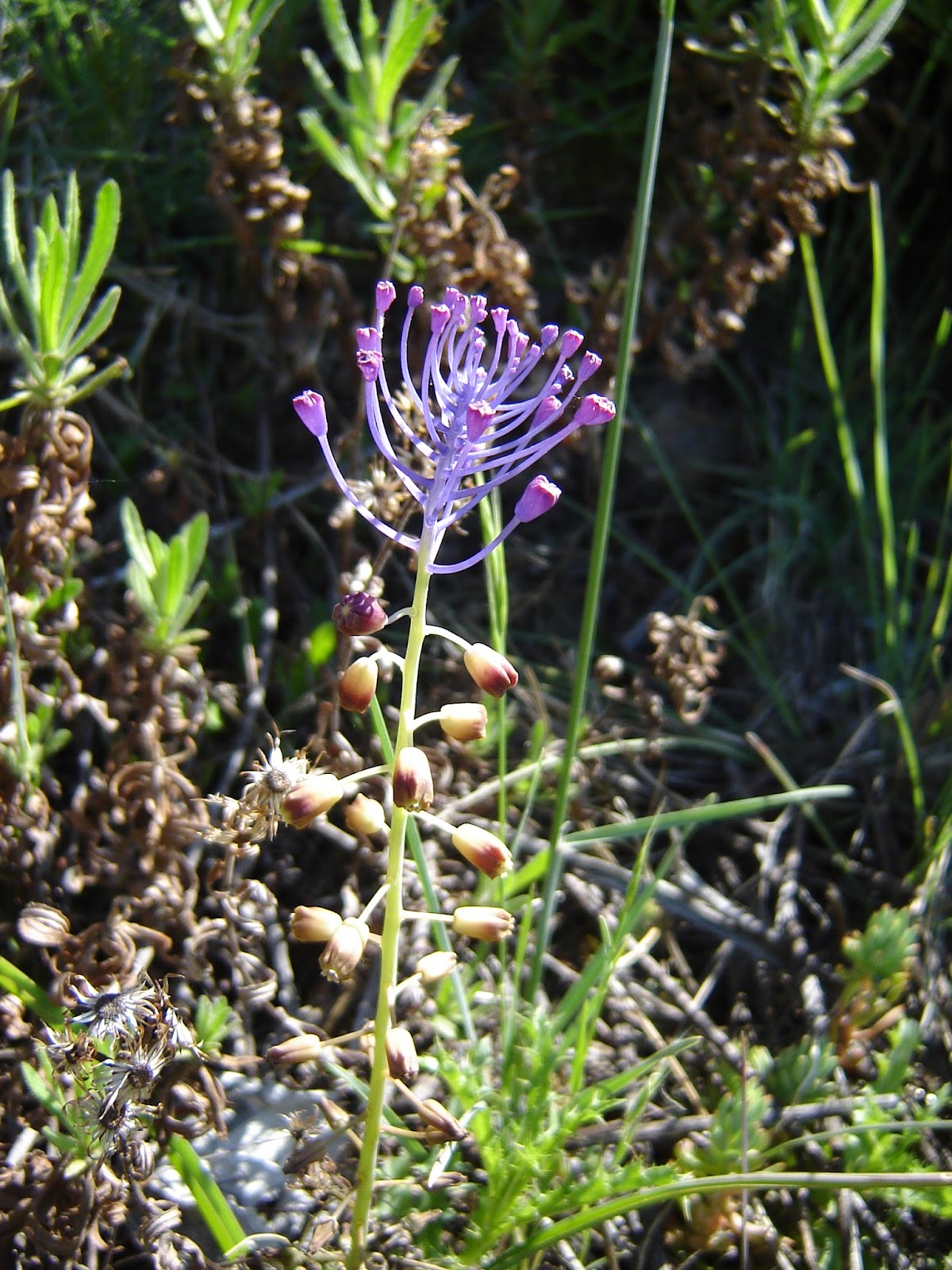


Notes: Tassel Hyacinth is one of a number of species and genera also known as grape hyacinths. It is a short to medium, rather slender bulbous perennial. The bulb of Muscari comosum is eadible and eaten in Italy and Greece.

Related key words: finca, Alpujarras, Arenales de Trevenque, Vereda de la Estrella, Sierra Nevada, Sierra de Huétor, Granada, Andalucía, Andalusia, Andalusië, Santa Elena (Biescas), Jánovas (Fiscal), Río Esera (Seira), Pirineos, Pyrenees, Pyreneeën, Picos de Europa, Alps

Asphodelus macrocarpus

English: White Asphodel - Asphodel
Nederlands: Witte affodil
Español: Gamón blanco - Abozo - Asfodelo - Gamoncillo - Varilla de San José
Français: Asphodèle blanc - Asphodèle de Villars
Deutsch: Weißer Affodill

Family: Liliaceae - Lily family
Flowering time: March-July
Height: 5-150cm
Altitude: to 2000m
Colour: white
Flower: funnel-shaped, diameter 4cm, six elongated petals
Leaves: in basal tufts, linear, pointed, grey-green
Habitat: meadows, heaths, open woodland, hilly and mountain habitats
Distribution: central and southern Spain, southwest France, southern Alps, western Balkans


Notes: Asphodelus is often seen in great numbers in areas subjected to grazig as they are generally unpalatable to livestock. The swollen roots of this plant are toxic. Two subspecies of Asphodelus macrocarpus are recognized, of which Asphodelus macrocarpus subsp. rubescens can be found for example in the Sierra de las Nieves, Sierras de Tejeda, Almijara and Alhama and Parque Natural Torcal de Antequera in southern Spain. Asphodelus albus subsp. delfinensis can be found in the Pyrenees, Asphodelus albus subsp. occidentalis in the Picos de Europa. Asphodelus fistulosus is a more delicate looking, less tall species that can not be found at higher altitudes. Asphodelus cerasiferus can also only be found at lower altitudes.

Related key words: Vereda de la Estrella, Jardín botánico Hoya de Pedraza, Sierra Nevada, Granada, Sierra de Huétor, Alpujarras, Tarifa Parque natural del Estrecho, Sierra de las Nieves, Andalucía, Andalusia, Andalusië, Pirineos, Pyrenees, Pyreneeën, Picos de Europa, Alps, insect, Xanthorrhoeaceae

Gagea lutea

English: Yellow Star-of-Bethlehem - Yellow Star of Bethlehem
Nederlands: Bosgeelster
Español:
Français: Gagée des bois - Gagée jaune - Ornithogale jaune
Deutsch: Wald-Gelbstern - Gewöhnlicher Gelbstern - Wald-Goldstern

Family: Liliaceae - Lily family
Flowering time: March-May
Height: 10-30cm
Altitude: to 1900m
Colour: yellow
Leaves: basal leaf solitary, linear-lanceolate, margin hairy
Habitat: clearings in deciduous woods, damp grassland, scrub
Distribution: widespread across much of Europe, especially in central Europe


Notes: Gagea lutea is a bulb-forming perennial herb that is occasionally cultivated in gardens. Stems are hairless and the umbel-like clusters have two to seven flowers (15-25mm). Each tepal has a band of green on the back.

Related key words: Landgoed Spaar en Hout Haarlem, stinsenplant, stinzenplant, stinzenflora, Stinsenplanze, plantes castrales

Veratrum album

English: White False Helleborine - European White Hellebore - White Veratrum
Nederlands: Witte nieswortel - Wit nieskruid
Español: Ballestera - Berdegambre - Baladre
Français: Vératre blanc - Hellébore blanc - Faux hellébore - Varaire
Deutsch: Weiße Germer - Nieswurz - Hemmerwurzn - Lauskraut - Lauswurz

Family: Liliaceas-Lily family
Flowering time: June - August
Height: 50-150cm
Altitude: 600 to 2700m
Colour: lime-green or yellow-white petals surround a light green centre
Leaves: ribbed, alternate, oval to elliptical, deep green, untoothed
Habitat: meadows, stream margins, damp clearings
Distribution: native of mountainous areas of Europe, from Lapland to Spain


Notes: Poisonous, medicinal plant with starry flowers that emanate a delicate perfume. The long woody stems have elongated ribbed leaves. Prior to flowering the plant can be confused with the Great Yellow Gentian. White False Helleborine contains a deadly toxin that was used in the preparation of poison-tipped spears.

Related key words: Pyrenees, Pyreneeën, Pirineos, Fajay de Pelay-Ordesa (Torla), Cerler-Ampriu (Benasque), Ibones de Anayet (Sallent de Gállego), Puerto del Pez (Gistaín), Picos de Europa, Alpine plant, central and southern Alps

Fritillaria meleagris

Fritillaria meleagris - Snakeshead Lily- Wilde kievitsbloem - Tablero de damas - Fritillaire pintade - Schachblume
English: Snakeshead Lily - Snake's head Fritillary - Snake's head - Chess flower
Nederlands: Wilde kievitsbloem
Español: Tablero de damas
Français: Fritillaire pintade - Oeuf de pintade - Gogane - Pintadine - Perrot
Deutsch: Schachblume

Family: Liliaceae - Lily family
Flowering time: April-May
Height: 20-50cm
Altitude: to 1200m
Colour: purple or pink with purple chequering, white
Habitat: damp water meadows, floodplains, open woodland
Distribution: native to the Netherlands, France and Germany


Note: The Snakeshead Lily is a garden plant and considered naturalized in Scandinavia and a number of central European countries. In the United Kingdom there is some disagreement amongst botanists as to whether Frittilaria meleagris is a native species or a long-established garden escapee.The Snakeshead Lily has become extinct in Belgium. In the Netherlands it is on the Red List, there are only a few growing places left. The banks of the river Vecht and Zwarte Water in the east of the country is the most important one and the second largest of Europe. The most important growing place of the Snakeshead Lily is to be found along the Loire in France.

Related key words:  Rotterdam, Botanische tuin Kralingen, Heemtuin Vlaardingen, Heemtuin Rucphen, Nederlandse Rode Lijst, stinsenflora, naturalized cultivar, Stinzeplanzen, plantes castrales

Tulipa sylvestris

Tulipa sylvestris - Wild Tulip - Bostulp - Tulipán silvestre - Tulipe des bois - Wilde Tulpe
English: Wild Tulip
Nederlands: Bostulp
Español: Tulipán silvestre - Burillas - Tulipán de los prados
Français: Tulipe des bois - Tulipe sauvage
Deutsch: Wilde Tulpe - Wald-Tulpe - Weinberg-Tulpe

Family: Liliaceae - Lily family
Flowering time: April-June
Height: 10-25cm
Altitude: to 1800m
Colour: yellow, three outer petals tinged with green, pink or crimson
Habitat: meadows, grassy, rocky, dry, sunny habitats
Distribution: Mountains of central, southern and southeastern Europe. Widely naturalized in northern Europe where it was introduced as a garden plant.


Note: Possibly introduced to northern Europe in the second half of the 16th century. In Spain the Tulipa sylvestris subsp. australis is recognized, a subspecies that grows in the mountains up to 2400m. At this altitude this ´Tulipán de los prados´ can be found flowering as late as June. In the Granada province it is relatively rare.

Related key words: Rotterdam, Kralingse Bos, Botanische tuin Kralingen, Heemtuin Rucphen, wylde tulp, begraafplaats Ternaard, kasteel Nijenrode, naturalized cultivar, stinsenplant, Stinsenpflanze, stinzenflora, plantes castrales, Sierra Nevada, Sierra de Huétor, Sierra Elvira, Sierra de Baza, Sierra de Lújar, Andalucía, Andalusië, Pyrenees, Pyreneeën, Pirineos, Peña Oroel (Jaca), Sierra de Santa Marina (Fiscal), Río Esera (Graus)

Ornithogalum orthophyllum

Ornithogalum orthophyllum - Leche de gallina
English:
Nederlands:
Español: Leche de gallina - Culebrilla ajera - Estrella de Belén - Leche de ave
Français:
Deutsch:

Family: Liliaceae - Lily family
Flowering time: June-August
Height: 10-15cm
Altitude: 1000-2300m
Colour: white
Habitat: meadows, rocky habitats
Distribution: Mediterranean region
Note: Toxic plant. Not in the western Pyrenees.


Related key words: Pyreneeën, Pirineos, Cerler-Ampriú (Benasque), Serveto (Plan), Barbaruéns (Seira), Andalucía, Los Alcornocales