Showing posts with label Purple. Show all posts

Linaria aeruginea subsp. aeruginea

English:
Nederlands:
Español: Conejillos
Français:
Deutsch:

Family: Plantaginaceae - Plantain family
Flowering time: April-July
Height: 5-20cm
Altitude: 200-2200m
Colour: brown-red, purple, violet, yellow or whitish
Flower: corolla 15-27 mm long, spur 5-11mm, to 35 flowers
Leaves: linear with margins rolled under
Habitat: dry rocky habitats, grasslands, scrub
Distribution: southern and eastern part the Iberian Peninsula and Balearic Islands
Synonym: Linaria melanantha


Notes: In the Sierra Nevada in southern Spain, there is another subspecies of Linaria aeruginea, namely Linaria aeruginea subsp. nevadensis. This subspecies has yellow flowers, is endemic to this mountain range and can be found at altitudes between 2300 and 3300 m.

Related key words: finca, Alpujarras, Arenales del Trevenque, Sierra Nevada, Sierra de Huétor, Sierra de Baza, Sierras Almijara y Tejeda, Sierra del Manar, Sierra de la Mora, Sierra de las Albuñuelas, Sierra de La Sagra, Granada, Sierra de las Nieves, Málaga, Andalucía, Andalusia, Andalusië, Veronicaceae, Scrophulariaceae

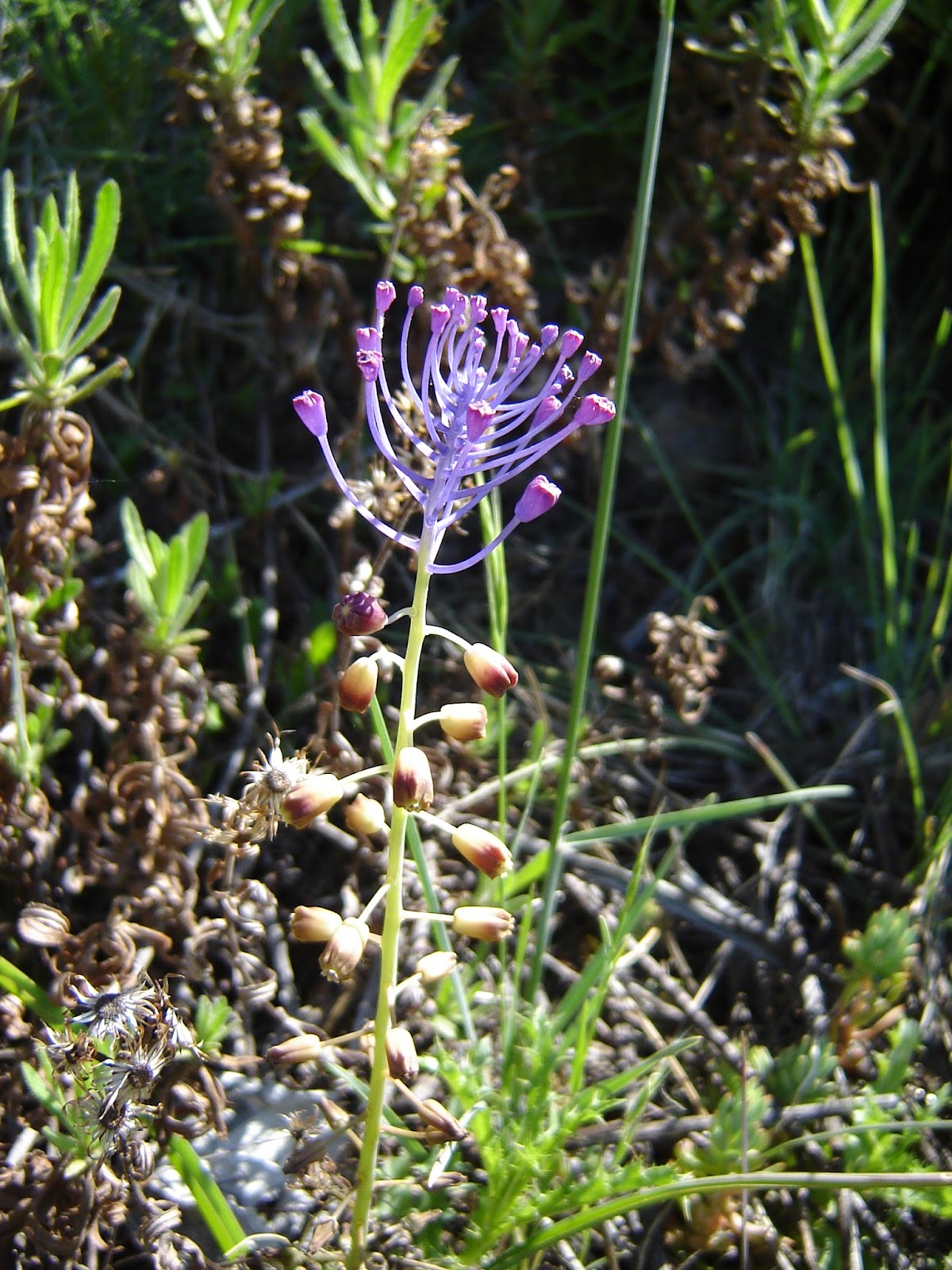
Muscari comosum

English: Tassel Hyacinth - Tufted Grape Hyacinth - Hairy Muscari - Edible Muscario
Nederlands: Kuifhyacint
Español: Jacinto comoso - Cebollón - Hierba del querer - Uguetas - Ajipuerco
Français: Muscari à toupet
Deutsch: Schopfige Traubenhyazinthe - Schopf-Traubenhyazinthe

Family: Liliaceae - Lily family
Flowering time: March-June
Height: 20-60cm
Altitude: to 1300m
Colour: blue, violet-purple, occasionally white
Flower: brownish with cream or pale yellowish-brown teeth, 5-10mm long, urn-shaped
Leaves: 3-6, linear or tapered gradually to the tip, 5-20mm long
Habitat: dry grassy habitats, roadsides, olive groves, vineyards, coastal thicket vegetation
Distribution: native to south-east Europe, naturalized elsewhere
Synonym: Leopoldia comosa


Notes: Tassel Hyacinth is one of a number of species and genera also known as grape hyacinths. It is a short to medium, rather slender bulbous perennial. The bulb of Muscari comosum is eadible and eaten in Italy and Greece.

Related key words: finca, Alpujarras, Arenales de Trevenque, Vereda de la Estrella, Sierra Nevada, Sierra de Huétor, Granada, Andalucía, Andalusia, Andalusië, Santa Elena (Biescas), Jánovas (Fiscal), Río Esera (Seira), Pirineos, Pyrenees, Pyreneeën, Picos de Europa, Alps

Agrostemma githago

English: Corncockle - Common Corncockle
Nederlands: Bolderik - Zwijnsoren - Christusoog - Bolderkruid
Español: Neguilla - Candelaria - Neguillón - Clavel del asno
Français: Nielle des blés
Deutsch: Kornrade - Ackerrade - Kornnelke - Kornrose

Family: Caryophyllaceae - Pink family
Flowering time: June-July
Height: 20-100cm
Altitude: to 2000m
Colour: purple-pink, seldom white
Flower: 30-50mm
Leaves: pale green, opposite, narrowly lanceolate, pointed
Habitat: fields, roadsides, railway lines, waste places, disturbed areas
Distribution: northern, western and mediterranean Europe
Synonym: Lychnis githago


Notes: In parts of Europe, intensive mechanised farming has put the plant at risk. It is a protected species in a number of countries and on the Dutch Red List (very rare) and Belgium Red List (threatened) of vascular plants.

Related key words: Vereda de la Estrella, Sierra Nevada, finca, Alpujarras, Granada, Andalucía, Andalusia, Andalusië, Pirineos, Pyrenees, Pyreneeën, Picos de Europa, Spain, Alps, Nederlandse Rode Lijst, Vlaamse Rode Lijst

Tragopogon porrifolius

English: Purple Salsify - Common Salsify - Oyster plant - Jerusalem Star - Goatsbeard
Nederlands: Paarse morgenster - Boksbaard - Haverwortel - Wilde schorseneer
Español: Salsifí común - Barba de cabra - Barbón
Français: Salsifis cultivé - Salsifis à feuilles de poireau - Salsifis de Provence
Deutsch: Haferwurzel - Habermark - Purpur-Bocksbart - Austernpflanze

Family: Asteraceae - Daisy family
Flowering time: April-June (southern Europe), May-August (northern Europe)
Height: 60-120cm
Altitude: to 1700m
Colour: lilac to dull reddish-purple
Flower: flower-heads 25-48mm
Leaves: broad-linear, widened at the base
Habitat: grassy habitats, waysides, cultivated and waste ground
Distribution: native to Mediterranean countries, introduced elsewhere


Notes: Tragopogon porrifolius is a mediterranean plant that has become naturalized in a number of European countries, for example in Denmark , the Netherlands, Sweden and Great Britain. The fleshy rootstocks of Salsify are edible when cooked and the young green shoots can be added to salads.

Related key words: Vereda de la Estrella, Sierra Nevada, finca, Alpujarras, Sierra de Huétor, Granada, Andalucía, Andalusia, Andalusië, Spain, Alps

Iris xiphium

English: Spanish Iris - Small Bulbous-rooted Iris
Nederlands:
Español: Lirio silvestre - Lirio azul - Lirio de primavera - Lirio español
Français: Iris à feuilles en glaive
Deutsch: Spanische Schwertlilie - Spanische Iris

Family: Iridaceae - Iris family
Flowering time: May-June
Height: 20-100cm
Altitude: to 1500
Colour: blue or violet-purple, rarely all yellow or white, yellow crest on the falls
Flower: falls with an unwinged haft and oval blade, 45-46mm long
Leaves: grey-green, slender, 3-5mm wide, channelled, appearing in the autumn
Habitat: open pine forests, grassy habitats, scrub, sandy or rocky ground
Distribution: Iberian Peninsula, southern France, eastern Italia
Synonym: Iris bulbosa angustifoliis odorata


Notes: Iris xiphium is a rather slender, medium, bulbous perennial that has long been cultivated. It is the common florist´s iris. A popular hybrid (Iris tingitana × Iris xiphium) is known as Dutch Iris or Iris × hollandica. In the Netherlands a number of naturalized plants of Iris xiphium have been found close to Arnhem. In the province of Granada in southern Spain it can be found in the Sierra Nevada, Sierra Tejeda y Almijara, Sierra de la Mora and in the comarca de El Temple-Alhama de Granada.

Related key words: Cumbres Verdes, La Zubia, Granada, Sierra Nevada, Anducía, Andalusia, Andalusië, Spain, insect

Cymbalaria muralis

English: Ivy-leaved Toadflax - Kenilworth Ivy - Coliseum Ivy - Oxford Ivy
Nederlands: Muurleeuwenbek
Español: Hierba de campanario - Palomilla de muro - Picardia
Français: Cymbalaire des murs - Linaire cymbalaire - Ruine-de-Rome
Deutsch: Zimbelkraut - Zymbelkraut - Mauer-Zimbelkraut

Family: Plantaginaceae - Plantain family
Flowering time: May-September
Height: 15-60cm
Altitude: to 2000m
Colour: lilac to violet with a yellowish patch on the flower lip
Flower: 9-15mm long, solitary on long stalks at the base
Leaves: ivy-like, kidney-shaped to almost rounded, 5-9 lobed, long-stalked
Habitat: shady rocks and woods, old walls, generally on calcareous soils
Distribution: native of the Mediterranean region, naturalized over almost the whole of Europe
Synonym: Linaria cymbalaria - Antirrhinum cymbalaria


Notes: The Ivy-leaved Toadflax was introduced in central Europe as an ornamental and medicinal plant in the 16th century. It is pollinated by bees. Before fertilization each flower pushes itself out into the light and sun, standing erect, but when the seeds are mature, it bends downward, buries the capsule in the dark crannies between the stones on which it grows, the seeds being thus dispersed by direct action of the plant itself.

Related key words: Natuurtuin Zoetermeer, Fort Rammekens Ritthem

Lamium purpureum

English: Red Deadnettle - Purple Deadnettle - Purple Archangel - Velikdenche
Nederlands: Paarse dovenetel
Español: Lamio púrpura - Ortiga roja - Ortiga muerta roja
Français: Lamier pourpre
Deutsch: Purpurrote Taubnessel

Family: Lamiaceae - Mint family
Flowering time: March-December (throughout the year)
Height: 5–30cm
Altitude: to 2500m
Colour: purple-pink, red purple
Flowers: 10-18mm long, with a straight corolla-tube
Leaves: oval, blunt-toothed, stalked, fine hairs
Habitat: roadsides, waste places, cultivated land, gardens, disturbed soils
Distribution: almost everywhere in Europe


Notes: Lamium purpureum is a short-lived annual, but seeds can germinate at almost any time of the year. This means it can also produce flowers throughout the year, including in the winter. This allows bees to gather pollen and nectar from this plant when few other sources are available.

Related key words: Kralingse Bos Rotterdam, insect, Andrena haemorrhoa, bee plant, Labiatae