Showing posts with label Stinsenplant. Show all posts

Corydalis cava

English: Bulbous Corydalis - Hollowroot
Nederlands: Holwortel
Español: Aristoloquia hueca - Apios de algunos - Aristoloquia pequeña
Français: Corydale creuse - Corydale à tubercule creux - Fumeterre creuse
Deutsch: Hohle Lerchensporn - Hohlknolliger Lerchensporn

Family: Papaveraceae - Poppy family
Flowering time: March-May
Height: 15-30cm
Altitude:
Colour: pinkish, purple, white
Leaves: bluish green, alternate bipinnate leaves
Habitat: woods, hegderows, cultivated land
Distribution: central Europe
Synonym: Corydalis bulbosa


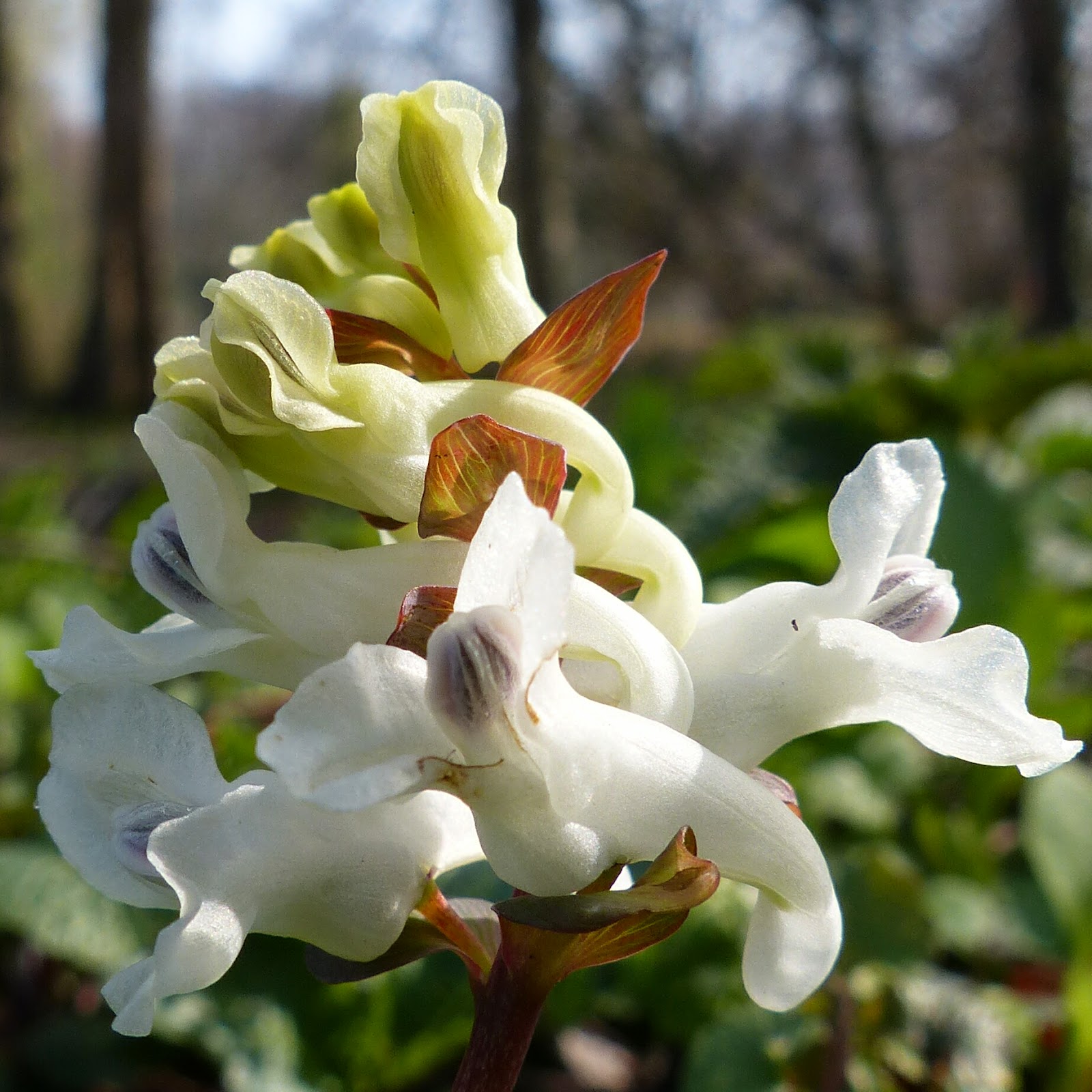


Notes: In some countries Corydalis cava is cultivated in gardens. It is naturalized in Belgium, Great Britain and the Netherlands amongst others. Similar to Solid-tubered Corydalis, but distinguished from this species by the absence of a bract-like scale at the base of the stem and by the undivided bracts.

Related key words: Stinsenlaantje Kralingse Bos Rotterdam, stinsenplant, stinzenplant, stinzenflora, Stinsenplanze, plantes castrales

Corydalis solida

English: Solid-tubered Corydalis - Fumewort - Bird in a Bush
Nederlands: Vingerhelmbloem - Vastwortelige helmbloem - Vogeltje-op-de-kruk
Español: Coridal
Français: Corydale à bulbe plein - Corydale à tubercule plein
Deutsch: Gefingerte Lerchensporn - Finger-Lerchensporn - Vollwurz-Lerchensporn

Family: Papaveraceae - Poppy family
Flowering time: March-April
Height: 10-25cm
Altitude: to 2200m
Colour: pale purple, rarely white
Leaves: ternate leaves that are arranged opposite one another, bluish green to grey-green
Habitat: woodland habitats, roadsides, hedgerows
Distribution: native to north and central Europe
Synonyms: Corydalis solida subsp. solida - Corydalis halleri - Corydalis transsylvanica


Notes: The siliques of Solid-tubered Corydalis ripen in May and June. The seeds are spread by ants and for this purpose they have small appendices that serve as food for these insects. Corydalis solida is widely cultivated and is an occasional garden esape, particularly in southern England. In the Netherlands it is native to the south and introduced and naturalized in other parts of the country.

Corydalis solida is a larval food plant of Clouded Apollo (Parnassius mnemosyne) a butterfly that can be found in mountainous areas in many different countries in Europe. In the Spanish Pyrenees both this flower and butterfly can be found for example in la Sarra (Sallent de Gállego).

Related key words: Stinsenlaantje Kralingse Bos Rotterdam, Spaar en Hout Haarlem, stinsenplant, stinzenplant, stinzenflora, Stinsenplanze, plantes castrales, Oza (Hecho), La Sarra (Sallent de Gállego), Pineta (Bielsa), Alps

Gagea lutea

English: Yellow Star-of-Bethlehem - Yellow Star of Bethlehem
Nederlands: Bosgeelster
Español:
Français: Gagée des bois - Gagée jaune - Ornithogale jaune
Deutsch: Wald-Gelbstern - Gewöhnlicher Gelbstern - Wald-Goldstern

Family: Liliaceae - Lily family
Flowering time: March-May
Height: 10-30cm
Altitude: to 1900m
Colour: yellow
Leaves: basal leaf solitary, linear-lanceolate, margin hairy
Habitat: clearings in deciduous woods, damp grassland, scrub
Distribution: widespread across much of Europe, especially in central Europe


Notes: Gagea lutea is a bulb-forming perennial herb that is occasionally cultivated in gardens. Stems are hairless and the umbel-like clusters have two to seven flowers (15-25mm). Each tepal has a band of green on the back.

Related key words: Landgoed Spaar en Hout Haarlem, stinsenplant, stinzenplant, stinzenflora, Stinsenplanze, plantes castrales

Scilla bifolia

English: Alpine Squill - Two-leaf Squill
Nederlands: Vroege sterhyacint
Español:
Français: Scille à deux feuilles - Étoile bleue
Deutsch: Zweiblättrige Blaustern - Sternhyazinthe - Zweiblättrige Meerzwiebel

Family: Asparagaceae - Asparagus family
Flowering time: March-June
Height: 10-25cm
Altitude: to 2000m
Colour: violet-blue, rarely white or lilac
Leaves: two or rarely three, broadly linear, lance-shaped, curved, fleshy, shiny
Habitat: shady places, woods of beech or deciduous trees, mountain meadows
Distribution: native to central and southern Europe (Belgium most northern country)


Notes: The flowering stems of Scilla bifolia are erect and unbranched. It grows from a bulb and the raceme bears six to ten flowers. The foliage of Alpine Squill will remain for a short time after flowering and then quickly die back in mid to late spring. This species spreads via seeds and dividing bulbs. It can form large carpets, for example in the northern Bovenrijndal in Germany. In this country Scilla bifolia is on the Red List of vascular plants and legally protected. In the Netherlands Alpine Squill is offered as a garden plant and has naturalized in forest parks. It can be found next to the Siberian squill, a relative that flowers at the same time. Both species are important nectar plants for honey bees in early spring.

Related key words: Rotterdam Kralingse Bos, Botanische tuin Kralingen, stinzenplant, stinzenflora, Stinsenplanze, plantes castrale, Alps

Scilla siberica

English: Siberian Squill
Nederlands: Oosterse sterhyacint
Español:
Français: Scille de Sibérie
Deutsch: Sibirischer Blaustern - Nickende Sternhyazinthe - Sibirische Sternhyazinthe

Family: Asparagaceae - Asparagus family
Flowering time: March-April
Height: 10-20cm
Altitude:
Colour: deep blue
Leaves: leaves two to four, oblong to broad-linear shaped
Habitat: deciduous woods and scrubb
Distribution: native to southwestern Russia, the Caucasus and Turkey


Notes: Siberian Squill has drooping, bell-shaped flowers, one to three on a common scape, often several scapes per bulb. After flowering, the flower stems become limp as capsules (pods) mature. At maturity, the capsules become purple and split open, releasing small, dark brown seeds. When the seeds are mature, the leaves wither and the plant goes dormant until the next spring. In the Netherlands the Scilla siberica has become naturalized.

Related key words: Rotterdam Kralingse Bos, Botanische tuin Kralingen, Landgoed Elswout Overveen, stinzenplant, stinzenflora, Stinsenplanze, plantes castrale

Leucojum vernum

English: Spring Snowflake
Nederlands: Lenteklokje
Español: Campanilla de primavera - Alhelí blanco de Teofrasto - Campanilla de Eguiluz
Français: Nivéole du printemps
Deutsch: Frühlings-Knotenblume - Märzenbecher - Märzbecher - Märzglöckchen - Großes Schneeglöckchen

Family: Amaryllidaea - Daffodil family
Flowering time: February - April
Height: 10-30cm
Altitude: to 1600m
Colour: white, with a green or yellow spot
Leaves: bright green, two or three, strap-shaped
Habitat: damp woods, hedgerows, meadow edges, streambanks
Distribution: native to mountainous areas of central and southern Europe


Notes: Flowers of the Spring Snowflake are solitary or paired, nodding, 15-25mm long, anthers orange. It starts flowering a few weeks later than Common Snowdrop. Spring Snowflake is widely cultivated and considered naturalized in a number of countries like Ireland, Great Britain and Denmark. Some people believe that it is native to the north-eastern part of the Netherlands (Oldenzaal, Twente). In Belgium it is native to the Meuse region and the southern Ardennes and in this country Leucojum vernum is on the Red List of vascular plants.

Related key words: Rotterdam, Botanische tuin Kralingen, Heemtuin Kralingse Bos, Landgoed Elswout Overveen, Sickengabos Wolvega, Maarteblomke, stinzenplant, stinzenflora, Stinsenplanze, plantes castrales, Vlaamse Rode Lijst